

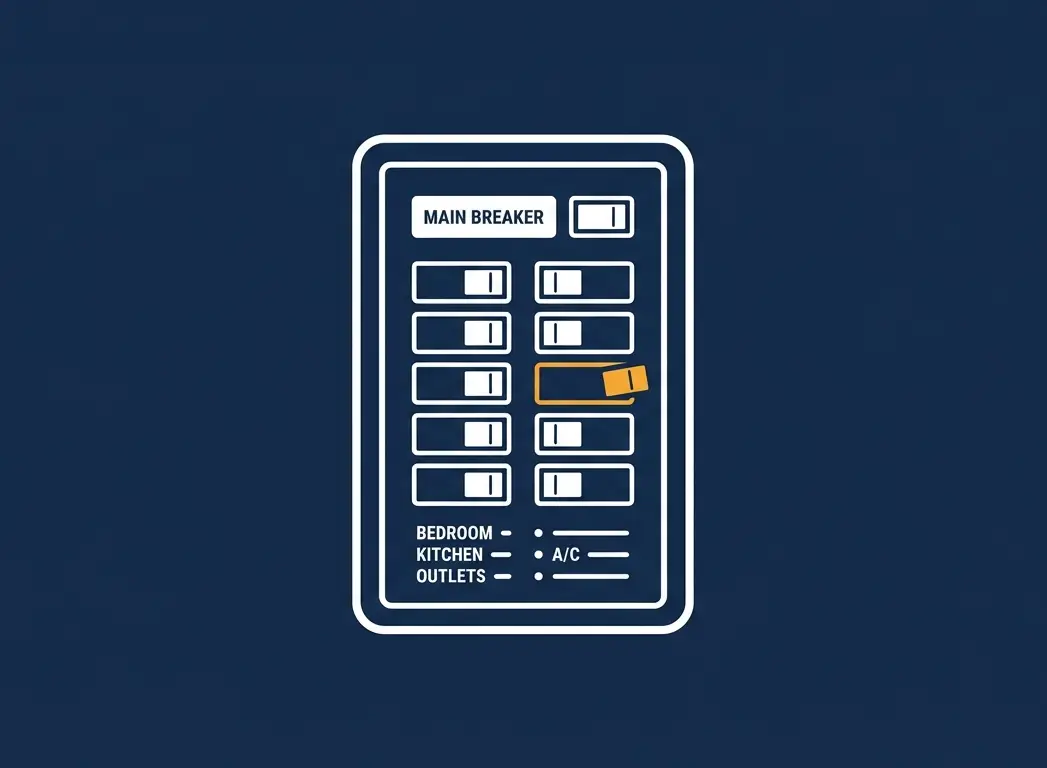
Why Does My Breaker Keep Tripping?
A breaker keeps tripping because it's doing its job — cutting power to stop a circuit from overheating. The most common cause is an overloaded circuit, but repeated tripping can also point to a short circuit, a ground fault, dangerous arcing, or a worn-out breaker that needs replacing.
A tripping breaker is frustrating, but it's also a safety device working exactly as designed. The key is figuring out why it keeps tripping — because some causes are a simple fix, and others are an early warning of a fire risk. Here's how to tell the difference.
The 5 Most Common Reasons a Breaker Keeps Tripping
1. Overloaded circuit (most common)
Every circuit is rated for a set amount of current — usually 15 or 20 amps. When you plug in too many high-draw devices at once (space heaters, hair dryers, microwaves), the demand exceeds that limit and the breaker trips to prevent overheating. If it trips when a specific appliance kicks on, or when you're running several things on the same circuit, overload is the likely culprit.
2. Short circuit
A short circuit happens when a hot wire touches a neutral wire, sending a surge of current through the circuit. The breaker trips instantly to shut it down. Warning signs include a burning smell, scorch marks around an outlet, or a breaker that trips again the moment you reset it. Short circuits are a genuine hazard and should be handled by a licensed electrician.
3. Ground fault
Similar to a short circuit, a ground fault occurs when a hot wire contacts a ground wire or a grounded part of the box — often in damp areas like kitchens, bathrooms, or outdoors. GFCI outlets and breakers are designed to catch these fast to prevent shock. If a GFCI keeps tripping in a wet area, don't ignore it.
4. Arc fault
Modern homes use AFCI breakers that detect dangerous electrical arcing — the kind caused by damaged wires, loose connections, or a nail through a cable. Arcing is a leading cause of electrical fires, so an AFCI breaker that trips repeatedly is flagging a real problem that needs to be traced and fixed.
5. A failing or outdated breaker
Breakers wear out. An aging breaker can trip at a lower threshold than it should, causing "nuisance" trips even when nothing's wrong with the circuit. Older panels — especially fuse boxes or brands with known safety defects — often need replacement. If your breaker trips with no clear overload, a worn breaker or an aging panel may be the issue, and upgrading the panel may be the safest long-term fix.
Quick Diagnosis: Which One Is It?
| What You Notice | Likely Cause |
|---|---|
| Trips when a big appliance turns on | Overloaded circuit |
| Trips instantly when reset; burning smell | Short circuit |
| Trips in kitchen, bath, or outdoors | Ground fault (GFCI) |
| Trips randomly across a room | Arc fault (AFCI) |
| Trips with little or nothing plugged in | Failing breaker or panel |
What to Do Right Now
- Note what was running when the breaker tripped — that's your biggest clue.
- Turn off and unplug the devices on that circuit.
- Reset the breaker: push it fully to off, then back to on.
- If it holds, plug devices back in one at a time to find the one that overloads it.
- If it trips again immediately — or with nothing plugged in — stop and call an electrician.
Important: don't repeatedly force a breaker back on if it keeps tripping. It's cutting power for a reason — repeatedly resetting it can overheat the wiring and create a fire risk.
When to Call a Licensed Electrician
Call a professional right away if you notice any of these:
- The breaker trips instantly, even with nothing plugged in
- A burning smell, scorch marks, or a warm panel
- Buzzing or crackling sounds from the panel
- Multiple breakers tripping, or frequent trips across the home
- An old fuse box or a panel that trips often for no clear reason
Breaker Still Tripping? Get Expert Help Today.
The Neighborhood Electrician connects you with a licensed, vetted electrician who can diagnose the problem safely — often the same day.
Frequently Asked Questions
Is it safe to keep resetting a breaker that keeps tripping?
No. A breaker trips to protect your wiring from overheating. Repeatedly resetting it without fixing the underlying cause can damage the circuit and increase the risk of an electrical fire. If it won't stay on, have it inspected.
Can a breaker trip for no reason?
There's almost always a cause, even if it isn't obvious. If a breaker trips with little or nothing running on the circuit, the breaker itself may be worn out or the panel may be aging — both jobs for a licensed electrician.
How much does it cost to fix a tripping breaker?
It depends on the cause. Replacing a single breaker typically runs $100–$300, while a full panel upgrade — sometimes needed for older or overloaded systems — runs $1,300–$4,000. Your electrician provides a firm quote after diagnosing the issue.
Why does my breaker trip when the AC turns on?
Large appliances like air conditioners draw a big surge of current at startup. If that circuit is already near capacity or the breaker is undersized or failing, that surge can trip it. An electrician can confirm whether it's an overload or a breaker issue.
Connecting U.S. homeowners with licensed, insured, and vetted electricians since 2015 — from emergency repairs to panel upgrades.
The Neighborhood Electrician is a referral service that connects homeowners with independent, licensed electrical contractors. We do not perform electrical work directly.